A bedroom can feel smaller than it is when every piece of furniture goes straight to the floor. A double bed with four visible legs chops the space into sections. Light stops at the frame. The vacuum cleaner negotiates around each post. A suspended double iron bed frame takes a different approach. The support structure sits so far back from the edges that the frame appears to hover. The floor runs clear underneath. The room breathes. But a bed is not a shelf. It holds two people shifting through the night, a mattress that can weigh forty kilograms or more, and the occasional person dropping onto the edge with their full body weight. Making that mass float without wobbling takes iron that is thick, joints that are continuous, and legs positioned with more calculation than intuition.
The Leverage Problem Nobody Sees
A suspended bed frame hides its legs well inside the perimeter, typically thirty to forty centimeters back from each corner. From standing height, the legs vanish into shadow. What remains visible is a frame hovering above the floor, connected to nothing. The trade-off is leverage. When someone sits on the side edge near a corner, their weight bears down on the unsupported overhang. The opposite side wants to lift. Thin-wall tubing cannot resist this. It flexes, the mattress tilts, and the floating illusion becomes the thing you notice for the wrong reason.
Solid iron perimeter rails at 3 millimeters or thicker provide the stiffness to keep the overhang steady under load. The material itself matters beyond thickness. Cast iron takes ornamental detail well but cracks under sudden impact. Wrought iron or worked steel bends before it breaks. It absorbs the small movements a bed makes as people shift position, climb in, roll over. Over thousands of cycles, that forgiveness is the difference between a frame that holds its shape and one that develops a permanent lean.
The joints deserve attention because they carry the floating design's entire reputation. Where the recessed legs meet the horizontal rails, continuous welded seams spread stress along the full length of the connection. Spot welds concentrate it at isolated points and eventually crack around them. Bolted connections work if the bracket interlock carries the load and the bolt mainly locates the pieces. When a bolt alone takes the shear force, it works loose under the vibration of daily use.
- Perimeter rails of solid iron at least 3 millimeters thick, providing the stiffness to keep unsupported corner spans from flexing under a seated person's weight
- Continuous welded seams at leg-to-rail joints rather than spot welds that crack around concentrated stress points
- Bolted connections where brackets interlock mechanically so the fastener locates rather than bearing the full shear load
- Legs positioned with enough setback to disappear from sight but not so far that the frame becomes tippy during edge-of-bed sitting
The Underside Nobody Used to See
On a standard bed with a valance or a solid base, the bottom of the frame is invisible. Nobody cares what the underside looks like. A suspended double iron bed frame changes that. The gap beneath the bed is open to view, and so is the bottom of every rail. A frame coated only on the visible surfaces will eventually show rust creeping from the hidden side. Powder coating applied to all surfaces—top, bottom, inside the rails and out—prevents this. The finish bonds electrostatically and cures into a layer that resists chips better than wet paint. Dark colors dominate not only for aesthetics but because they recede visually, deepening the floating effect rather than drawing the eye down to the hardware.
The height of the gap matters too. Too low and the floating effect fails to register. Too high and the bed feels precarious, plus the space underneath becomes a dust trap too narrow for easy cleaning. A gap of fifteen to twenty centimeters usually balances the visual float with practical access for a vacuum or mop.
The Slats and the Silence Test
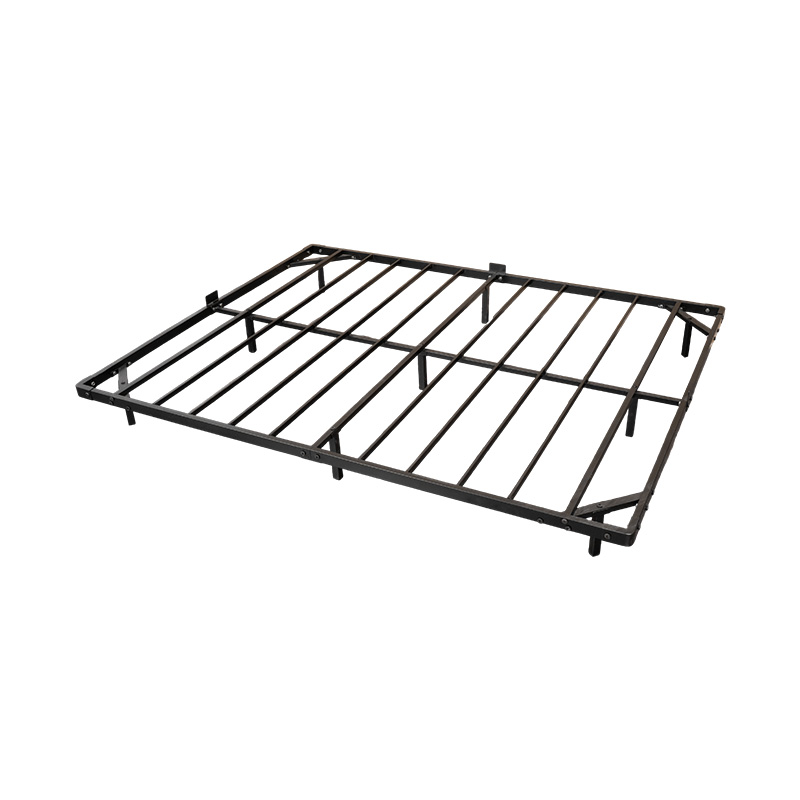
The iron frame provides the perimeter structure, but the sleeping surface depends on what spans between the rails. A double bed with slats spaced too wide lets the mattress compress into the gaps. Support becomes uneven. The mattress sags prematurely. Slat spacing of eight centimeters or less keeps the mattress properly supported across its entire surface. A center support rail running from head to foot prevents the slats from bowing under combined weight. Without it, two sleepers gradually roll toward the middle as the slats curve downward over months of use.
The interface between slat and iron frame determines how much noise the bed makes. Metal on wood creaks with every shift of body position. A small felt strip or rubber gasket at each contact point silences the connection. The cost of these isolators in production is small. Their absence is noticed the first sleepless night when every turn produces a sound from somewhere underneath.
- Slats spaced no more than 8 centimeters apart to keep the mattress from compressing into the gaps and losing support
- A full-length center support rail preventing slat bow and the slow roll-together that unsupported double beds develop
- Felt or rubber isolators at every slat-to-frame contact point, eliminating the creak that amplifies every movement in the quiet of a bedroom
Assembly and the Moving Day Test
A suspended double iron bed frame typically arrives in pieces. The connection design determines whether it assembles into one rigid unit or a collection of parts that shift against each other. Brackets that interlock before bolting provide mechanical registration. The pieces align themselves rather than depending on the assembler to hold everything in position while tightening fasteners. A frame assembled slightly out of square transmits that error through the whole structure. One corner sits higher. The mattress rocks. Bolts loosen over months as they take loads they were never designed to carry alone.
Moving day exposes the difference between thoughtful design and assembly indifference. A bed that requires six different bolt sizes and three different tools turns a straightforward task into frustration. A design that uses the same bolt size throughout, with captive nuts welded to the frame so no one has to fish around inside blind cavities with a wrench, comes apart and goes back together without drama.
A suspended double iron bed frame built to these standards does more than look clean. The open floor underneath makes the room feel larger and simplifies cleaning. The iron, properly finished on all surfaces, resists rust in humid climates where hidden corrosion usually starts. The joints hold quiet through years of shifting loads. The frame outlasts its mattress and probably its owner's next change of decorating taste. What makes the floating look work is not a design secret but a series of unglamorous choices—thicker iron, continuous welds, full powder coating, felt pads where metal meets wood. None of it shows in a photograph. All of it shows the first night someone drops onto the edge and the frame does not flinch.


 中文简体
中文简体